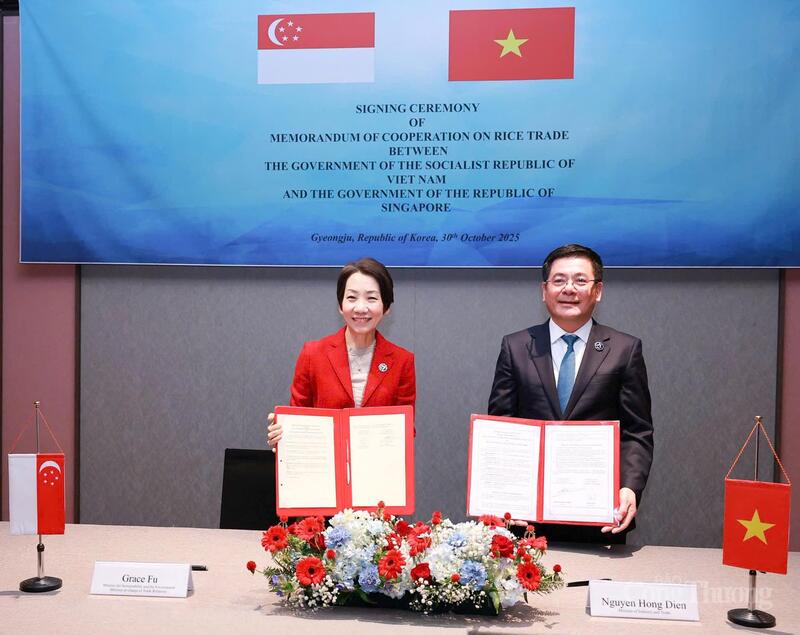
Vietnam – Singapore signed a memorandum of understanding on rice trade cooperation, ensuring food security.
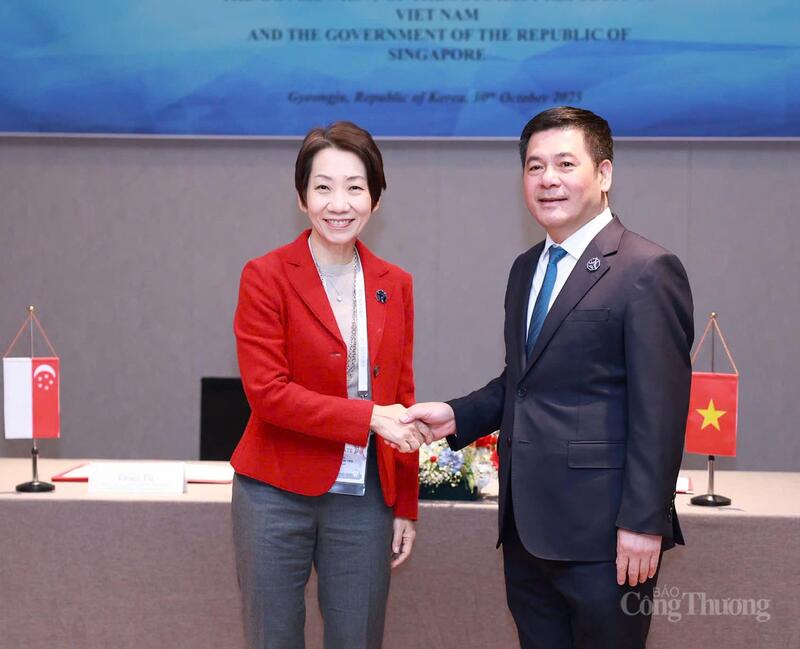
On October 30, Minister Nguyen Hong Dien and the Minister of Environment and Sustainable Development, and Minister in charge of Trade Relations of Singapore signed the MOC on rice trade.
On October 30, 2025, on the sidelines of the Asia-Pacific Economic Cooperation (APEC) Summit held in Gyeongju, South Korea, Minister of Industry and Trade Nguyen Hong Dien had a bilateral meeting and working session with the Minister of Environment and Sustainable Development, and Minister in charge of Trade Relations of Singapore – Ms. Grace Fu.
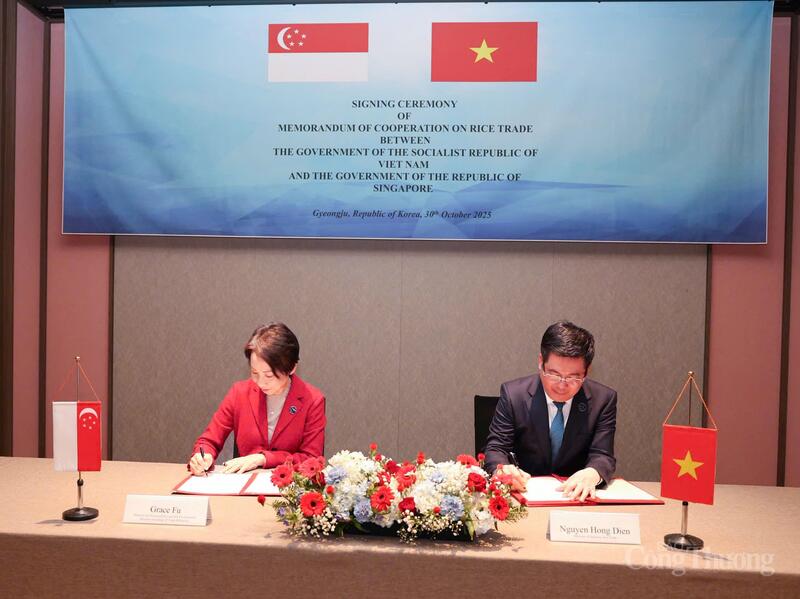
During the bilateral working session, Minister of Sustainable Development and Environment, and Minister in charge of Trade Relations of Singapore Grace Fu, and Minister of Industry and Trade of Vietnam Nguyen Hong Dien signed the Memorandum of Understanding on rice trade cooperation between the two countries (MOC).
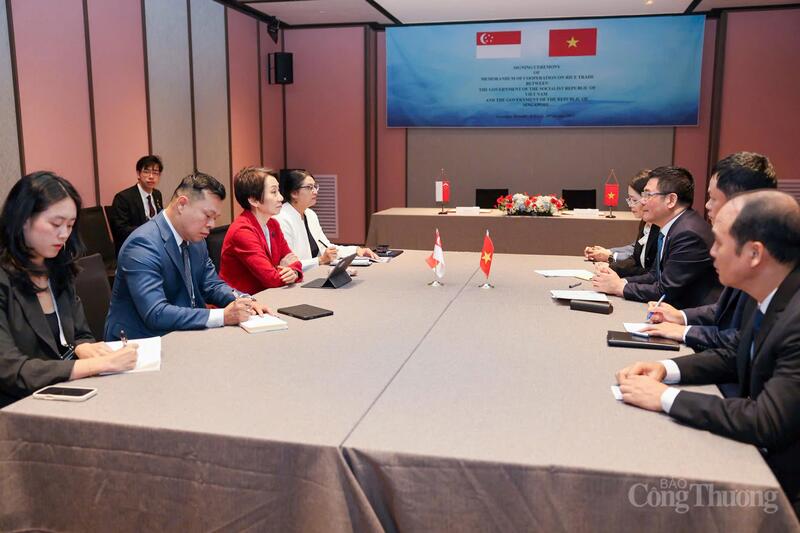
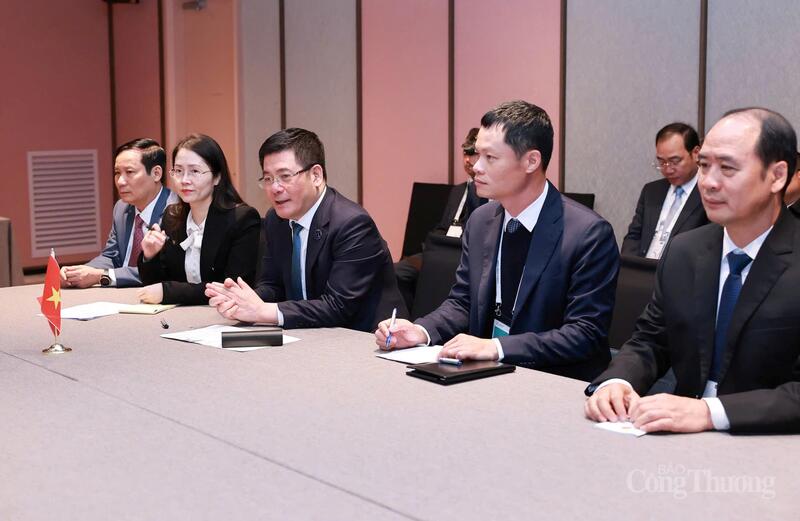
Accompanying Minister Nguyen Hong Dien to the meeting and working session were representatives of specialized departments and the Vietnam Trade Office in Singapore…
On the Singapore side, representatives of relevant specialized units accompanied Minister Grace Fu.
Minister of Industry and Trade Nguyen Hong Dien and Minister of Environment and Sustainable Development, and Minister in charge of trade relations of Singapore – Ms. Grace Fu.
Foundation for promoting stable and sustainable development of rice trade
During the meeting, the two Ministers highly appreciated the positive growth of economic and trade cooperation between the two countries in recent times.
Regarding the Memorandum of Understanding on rice trade cooperation, Minister Nguyen Hong Dien thanked Minister Grace Fu for actively directing relevant agencies to closely coordinate with the Ministry of Industry and Trade of Vietnam to complete negotiations and sign the Memorandum of Understanding on rice trade cooperation between the two Governments in a very short time, just over 3 months.
Minister Nguyen Hong Dien emphasized that the Memorandum of Understanding on cooperation is the basis for promoting stable and sustainable development of rice trade, contributing to ensuring bilateral food security, by avoiding the application of unnecessary trade restrictions.
Overview of the bilateral working session between Minister of Industry and Trade Nguyen Hong Dien and Minister of Environment and Sustainable Development, and Minister in charge of trade relations of Singapore – Ms. Grace Fu.
According to the MoU, Vietnam will facilitate rice exports to Singapore in an amount agreed upon by both sides, subject to specific conditions, based on Singapore’s demand.
Similarly, Minister Grace Fu also said that this is the first MoU on rice trade cooperation that Singapore has signed with a partner, and we are very pleased that the partner is Vietnam – one of Singapore’s largest rice suppliers.
According to Minister Grace Fu, as a country that imports more than 90% of its food needs, Singapore cannot avoid the impacts of disruptions in the global supply chain. Therefore, establishing global and regional partnerships is essential to ensure a stable rice supply for Singapore.
Singapore is a leading economic partner and an important market of Vietnam. The signing of the Memorandum of Understanding on rice trade cooperation is a concrete step to implement the Comprehensive Strategic Partnership, contributing to strengthening the connection between the two economies, creating a foundation for stable and sustainable cooperation in the field of rice trade in the context of unpredictable fluctuations in the global market.
At the same time, contributing to strengthening rice trade cooperation between Vietnam and Singapore is also a concrete demonstration of coordinated efforts to ensure supply chains and food security in ASEAN.
Minister Nguyen Hong Dien proposed many solutions to soon put the Memorandum of Understanding on rice trade cooperation between the two countries into practice.
To put the Memorandum of Understanding into practice soon, Vietnamese Minister of Industry and Trade Nguyen Hong Dien suggested that Vietnam and Singapore should:
First, promptly designate a focal point for implementation and agree on a specific coordination mechanism between the Foreign Market Development Department and the Singapore Food Agency (SFA).
Second, develop an Action Plan for the period 2025 – 2026, including trade promotion activities, sharing market information and supporting businesses of the two countries.
Third, the two countries need to maintain a regular annual exchange mechanism to review progress and promptly adjust cooperation contents to suit the actual situation.
“I propose that Singapore continue to facilitate Vietnamese enterprises to access the Singapore market, especially the introduction and distribution of high-quality Vietnamese rice and agricultural and aquatic products in Singapore’s supermarket systems, large retail chains and e-commerce channels,” Minister Nguyen Hong Dien suggested.
Expanding agricultural and food cooperation
Along with promoting stable and sustainable rice trade cooperation between Vietnam and Singapore, during the working session with Minister Grace Fu, Minister Nguyen Hong Dien also proposed that the two countries expand agricultural and food trade cooperation.
According to Minister Nguyen Hong Dien, in recent times, Singapore has officially opened its market to a number of Vietnamese livestock products such as poultry meat and eggs, which is an encouraging result, demonstrating the trust and effective cooperation between the competent authorities of the two countries. Therefore, to promote this result, the Minister suggested that the two sides continue to coordinate more closely to expand the import of high-quality and prestigious Vietnamese agricultural and aquatic products into the Singapore market.
Singapore’s Minister for Sustainable Development and Environment and Minister in charge of Trade Relations Grace Fu and Vietnam’s Minister of Industry and Trade Nguyen Hong Dien signed a Memorandum of Understanding on rice trade cooperation.
The Memorandum of Cooperation is the basis for promoting stable and sustainable development of rice trade, contributing to ensuring bilateral food security, through avoiding the application of unnecessary trade restrictions.
In addition, Minister Nguyen Hong Dien also suggested that the two ministries could expand cooperation to areas where Singapore has strengths and Vietnam is interested, especially green transformation, sustainable development and circular economy. These are areas that are in line with Vietnam’s development orientation in the coming period, as well as Singapore’s priorities in national development policy.
The Vietnamese Minister of Industry and Trade affirmed that Vietnam is ready to coordinate with the Singapore Ministry of Environment and Sustainable Development to, first of all, exchange policy experiences on circular economic development, cleaner production and emission reduction in industries;
Secondly, encourage businesses of the two countries to cooperate in green areas, such as recycling industry, waste treatment technology, carbon emission reduction, and sustainable production and consumption;
Third, support connections between businesses of the two countries in investment projects on environment, renewable energy, and green logistics, contributing to the implementation of the two countries’ commitment to net zero emissions.
Focus on trade promotion, enhancing the image of Vietnamese rice
Regarding the Memorandum of Understanding on rice trade cooperation between Vietnam and Singapore, from the local market, sharing with reporters of the Industry and Trade Newspaper, Mr. Cao Xuan Thang – Trade Counselor, Head of the Vietnam Trade Office in Singapore said that in the Singapore market, Vietnam is the country with the largest market share for 3 rice groups: White rice (accounting for 42.23%); fragrant rice, milled or peeled (accounting for 65.73%) and sticky rice (77.02%). With the above results, Vietnam currently maintains its position as the 3rd largest rice supplier to Singapore, after India and Thailand.
In the first 9 months of 2025, the import value of rice products in general from Vietnam to Singapore reached 87.8 million SGD, down 11.5% compared to the same period in 2024, accounting for 25.3% of the total market share of imported rice in this market.
Although the size of the Singapore market has not changed significantly, in terms of import value, the total value of Vietnam’s rice imports into Singapore has decreased compared to the same period, which is believed to be due to the general decrease in Vietnam’s rice export price compared to 2024.
Currently, white rice (10063099) is the group with the highest import value among Vietnam’s rice product groups into the Singapore market, in the first 9 months of 2025, reaching 53.2 million SGD, an increase of 10.1% over the same period in 2024, accounting for 31% of the market share.
Also according to statistics recorded by the Singapore Enterprise Management Authority, White rice (10063099) is the group for which Singapore has a high level of diversity of foreign supply sources (over 20 partner countries). However, Vietnam’s market share in this group is currently second only to India (75.2 million SGD, accounting for 43.8% of the market share).
In addition to white rice, Vietnam has two other groups with high import value in the Singapore market, namely Fragrant rice (10063070) and Glutinous rice (10063030), with import value in the first 9 months of the year reaching 24.6 million USD and 6.7 million USD, accounting for 59.7% and 63.2% of the import market share in Singapore, respectively.
Although the import value of these two groups from Vietnam to Singapore continues to show signs of decreasing compared to the same period in 2024 due to the reason for the export price of rice as mentioned, Vietnam is still temporarily holding the leading position in the import source of these two groups into Singapore.
Trade Counselor Cao Xuan Thang commented that the domestic market in Singapore is saturated, with the scale of the imported rice market in Singapore maintained stable, Vietnamese rice will continue to face great competition from similar products from India, Thailand and Japan.
Therefore, the signing of the Memorandum of Understanding (MOC) on Rice Trade between Singapore and Vietnam will contribute to stabilizing Vietnam’s rice export source to Singapore in the coming time.
However, Counselor Cao Xuan Thang said that in terms of trade promotion, the promotion and introduction of Vietnamese rice products in the market is still quite limited, there seems to be no large-scale promotion activities by enterprises and associations of the Vietnamese rice industry. Currently, the main activities for trade promotion and display of Vietnamese rice products are implemented by the Vietnam Trade Office in Singapore. Meanwhile, countries such as Thailand, Japan, and India are very interested in investing in promoting product images and have agreements with importers and distributors on keeping the names and brands of their rice products.
Not only that, stating the reality, Counselor Cao Xuan Thang also said that Vietnamese enterprises have not focused on investing in large-scale product promotion and introduction activities. Importers and distribution systems in Singapore mainly import Vietnamese rice packaged with Singaporean designs, packaging and domestic brands for easy consumption in the market. Vietnamese branded rice products are almost only consumed in small convenience stores or online sales agents of Vietnamese people.
“After the first two quarters of the year holding the leading position in rice exports to the Singaporean market, Vietnam has lost market share to India and Thailand. This shows that businesses need to try harder to find ways to improve competitiveness and quality of rice products, because the Singaporean rice market is closely managed by the Singaporean Government, as shown by the Singaporean Government’s approval and licensing of imports as well as direct inspection and testing of rice quality before it is put on the market.
Businesses also need to determine that Vietnamese rice products are not only consumed in the Singaporean market but are also exported by Singaporean businesses to other countries around the world. Therefore, businesses need to pay attention to the important role of Singapore’s transit area, not just the area of nearly 6 million people of this island nation” – Commercial Counselor, Vietnam Trade Office in Singapore recommended.